ASTM A500 Grade B vs. Grade C: Choosing the Right HSS for Data Center Framing

In the high-stakes environment of data center construction, the facility's structural framework ensures the safety of millions of dollars' worth of IT assets. As rack densities climb and liquid-cooled systems add significant weight to floor loads, choosing the right Hollow Structural Sections (HSS) becomes a critical engineering decision.
At Sintel, we specialize in large-scale fabrication and design for manufacturing, ensuring your material choice results in a high-quality build. A common question we encounter is whether to specify ASTM A500 Grade B or Grade C for data center framing, cable management systems, and server rack supports.
While these two grades look identical to the naked eye, their mechanical properties and performance under load can significantly impact your project’s scalability and cost. Here is how to choose the right Hollow Structural Section (HSS) for your next data center project.
Understanding the Material: Feature vs. Benefit
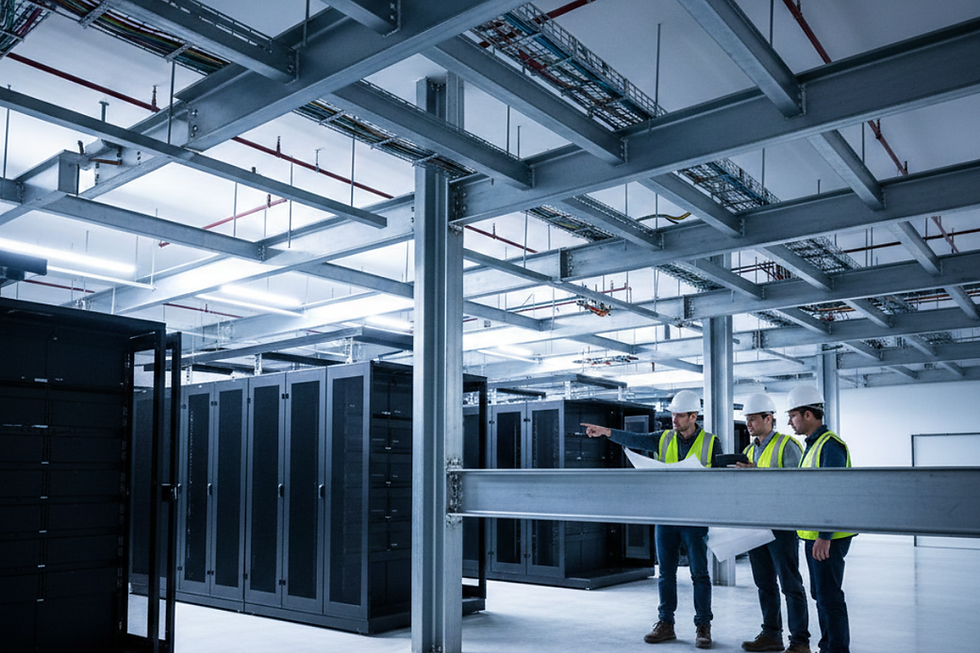
Choosing between Grade B and Grade C depends on how the material performs during fabrication and how it protects your project timeline.
ASTM A500 Gr B: The Reliable Standard
ASTM A500 Gr B is the most widely used grade for cold-formed welded structural tubing.
The Feature: High ductility and excellent weldability.
The Benefit: As the industry standard, it offers the most reliable lead times. For data center contractors, this means avoiding logistics headaches and ensuring best-in-class on-time delivery for large-scale framing components.
ASTM A500 Gr C: The High-Strength Alternative
ASTM A500 Gr C provides higher minimum yield and tensile strengths than Grade B.
The Feature: Increased strength-to-weight ratio.
The Benefit: Using Grade C allows you to use lighter-weight sections without sacrificing structural integrity. In a data center environment, this can reduce the overall weight on the building's foundation and make the installation of "big heavy parts" more manageable for your on-site teams.
Why Sintel for Data Center Framing?
Selecting the right steel is only half the battle. How that steel is processed determines the success of your assembly. Sintel provides a "single supplier" advantage that eliminates the friction of coordinating multiple vendors.
1. Advanced Robotics & Automation
We utilize robotic welding and advanced automation to process ASTM A500 Gr. B and ASTM A500 Gr. C with unmatched consistency.
The Benefit: Automation ensures that every frame in a 500-rack deployment is identical, facilitating easier integration with "hot-aisle" containment and reducing field-fit issues.
2. Large-Scale Powder Coating
As a Made in USA manufacturer, Sintel offers in-house Powder Coat services for massive structural assemblies.
The Benefit: By powder coating in-house, we eliminate the risk of transit damage between a fabricator and a coater. You receive a finished, durable product that is ready for the data center floor, backed by the quality of a company that has successfully passed audits for the world’s most demanding tech giants.
3. Direct-from-Mill Procurement
Sintel has established a robust supply chain that allows us to procure ASTM A500 Gr. B and ASTM A500 Gr. C directly from the best mills.
The Benefit: We provide our customers with more competitive pricing and guaranteed material traceability. This direct relationship ensures we have the "heavy" materials you need, even when the broader market faces shortages.
4. Design for Cost Savings
With decades of experience designing with both grades, our engineering team helps you optimize your project for maximum cost-effectiveness.
The Benefit: We often identify opportunities where switching to ASTM A500 Gr. C allows for thinner wall thicknesses, reducing total steel weight and shipping costs. Conversely, if availability is the priority, we can optimize designs for Grade B to ensure your project stays on schedule without over-engineering costs.
Comparing the Specs: A Quick Reference
According to industry standards and comparative data, the primary difference lies in the mechanical properties:
Property | Grade B (Shaped) | Grade C (Shaped) |
Yield Strength (min) | 46,000 psi | 50,000 psi |
Tensile Strength (min) | 58,000 psi | 62,000 psi |
While ASTM A500 Gr. C offers roughly a 10% increase in yield strength, ASTM A500 Gr. B remains the go-to for general framing, where maximum strength-to-weight isn't the primary driver but availability is.
FAQs
1. What is the difference between ASTM A500 Gr B and Grade C for structural use?
The primary difference is strength. ASTM A500 Gr C offers higher yield and tensile strength compared to Grade B. This allows engineers to specify thinner walls or smaller sections to carry the same load, reducing the weight of large-scale data center frames.
2. Which HSS grade is better for welding data center racks?
Both ASTM A500 Gr. B and ASTM A500 Gr. C has excellent weldability. However, Grade B is often preferred for high-volume robotic welding due to its slightly higher ductility and widespread availability, which help ensure consistent results across massive production runs.
3. Is ASTM A500 Grade C more expensive than Grade B?
While the base material cost of Grade C can be slightly higher, it often results in overall project savings. Because it is stronger, you may use less steel by weight, reducing material costs and making the fabrication of "big heavy parts" more efficient.
4. Can I substitute Grade C for Grade B in my construction project?
In most cases, yes. Since Grade C has higher strength properties than Grade B, it is usually an acceptable substitute. However, you should always consult your design team to ensure that the higher strength doesn't affect other design factors, such as flexibility or specific connection requirements.
5. Does Sintel provide finishing for ASTM A500 structural tubing?
Yes, Sintel offers in-house Powder Coat services for all HSS fabrications. This provides a durable, professional finish that protects against corrosion and meets the aesthetic requirements of modern data center environments, all while keeping the entire process under one roof for better quality control.


Comments