Why Data Centers Need Battery Energy Storage Systems (BESS) & Custom Metal Enclosures

Quick Answer: Data centers require Battery Energy Storage Systems (BESS) to buffer rising power demand, bridge outages longer than standard UPS units, and cut peak demand charges. However, BESS reliability depends on heavy-duty, custom-engineered metal enclosures that provide essential thermal management, fire containment, and weatherproofing.
Power demand across mission-critical and electrification infrastructure is climbing rapidly, leaving traditional backup power systems struggling to keep up. Modern data centers require continuous, 24/7 power—forcing operators to balance 99.999% uptime requirements with sustainability goals and grid stability.
Battery Energy Storage Systems (BESS) are no longer optional. Operating alongside traditional tools like diesel backup generators and standard Uninterruptible Power Supply (UPS) systems, BESS has become essential for modern data center energy management, peak load balancing, and grid resiliency.
Below is an overview of why BESS matters for mission-critical infrastructure and the critical role precision-engineered metal enclosures play in safety, thermal management, and long-term reliability.
The Power Challenge Facing Modern Data Centers

Data centers are consuming unprecedented levels of power. Driven by high-density AI workloads, cloud expansion, and growing digital infrastructure, facility power demand is projected to increase significantly through 2030. This rapid growth puts immense pressure on aging utility grid systems that were not designed for modern peak demand curves.
Facilities face frequent power and operational challenges:
Severe demand spikes: Rapid load shifts caused by intensive parallel computing and machine learning training cycles.
Voltage fluctuations: Dips, sags, and frequency irregularities that compromise sensitive server hardware.
Limited runtime: Standard UPS battery runtime is typically measured in minutes, while diesel generators face rising fuel costs, maintenance overhead, and strict emissions regulations.
To bridge these gaps, data centers deploy BESS alongside traditional infrastructure as a core requirement for complete power reliability.
4 Key Operational Benefits of BESS
A Battery Energy Storage System pairs high-density battery banks (such as Lithium-Ion or LFP chemistry) with bidirectional inverters, thermal management, and smart control software to store energy and release it on demand.
Extended Backup Power
Bridges power outages longer than standard UPS units, giving backup generators time to safely sync or eliminating short-duration generator runs entirely.
Peak Shaving & Load Levelling
Discharges stored energy during peak tariff hours to flatten utility usage spikes and significantly reduce capacity/demand charges.
Power Quality & Grid Support
Cleans incoming line power, buffering voltage fluctuations and harmonics before they reach sensitive IT racks.
ESG & Renewable Integration
Integrates on-site renewables (like solar PV) with grid power to reduce reliance on fossil-fuel generators and support corporate carbon-neutral goals.
The Critical Bottleneck: BESS Enclosure Engineering
While batteries and inverters get most of the attention in BESS conversations, the enclosure and structural housing represent one of the biggest operational constraints in BESS deployment today. A battery system is only as reliable as the frame, cabinet, or container protecting it from environmental exposure, thermal stress, and mechanical vibration.
Without a properly engineered enclosure, thermal management fails, local footprint constraints stall deployment, and safety risks—such as thermal runaway propagation—increase significantly.
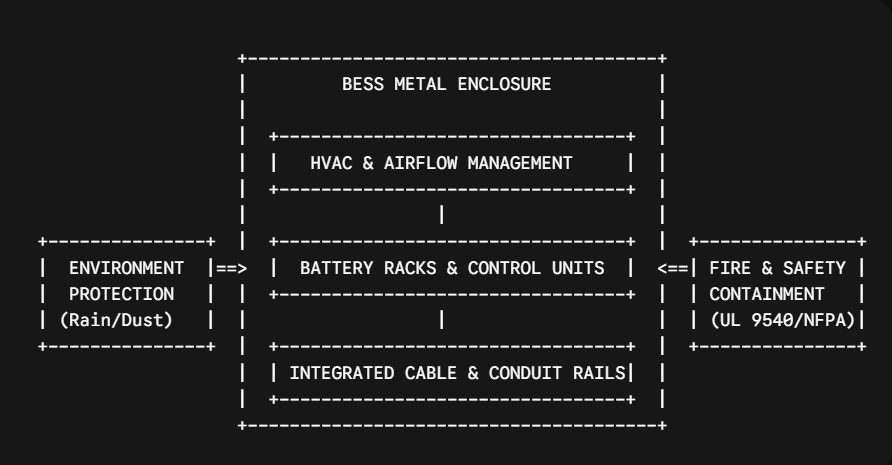
Well-engineered metal BESS enclosures support:
Thermal Management: Precision-designed airflow paths, HVAC integration, and heat dissipation around battery modules to maintain optimal operating temperatures.
Structural Safety & Compliance: Heavy-gauge metal protection designed to meet fire and life-safety standards, including NFPA 855 installation standards and UL 9540 / UL 9540A system listings.
Environmental Protection: Weather-sealed outer shells engineered for extreme outdoor temperatures, dust ingress, and seismic activity.
Integrated Routing: Dedicated internal channels for power cables, signal conduits, and fire-suppression piping to reduce maintenance complexity.
Aligning metal fabrication early in the design process ensures structural integrity and helps operators avoid expensive engineering rework later in the build cycle.
High-Volume Metal Fabrication for Infrastructure Scale
Data center and electrification projects rarely require single custom components; they demand consistent, high-volume production delivered across multi-site rollouts. Achieving this consistency requires a fabrication partner equipped for scale.
Sintel brings over 40 years of experience in large-part metal fabrication, serving energy, data center, and mission-critical industries. Operating from a dedicated manufacturing facility, Sintel delivers custom enclosures, server racks, electrical cabinets, and aisle containment systems designed strictly around Design for Manufacturing (DFM) principles.
Sintel Core Fabrication Capabilities:
Large & Heavy Weldments: High-capacity structural frames built to support heavy battery racks and high-density electrical gear.
Robotic Welding: Automated welding cells that deliver rapid, repeatable quality across multi-site production runs.
In-House Powder Coating: Durable exterior finishing that protects steel and aluminum enclosures against long-term corrosion.
Turnkey Electro-Mechanical Assembly: Complete structural assembly integrated with mounting hardware and sub-assemblies ready for drop-in deployment.
Frequently Asked Questions (FAQs)
1. Why do data centers need battery energy storage systems (BESS)?
Data centers need BESS to manage increasing power densities, protect equipment from grid instability, extend backup power beyond traditional UPS runtimes, and reduce peak demand charges while meeting corporate sustainability targets.
2. What is a BESS enclosure, and why does it matter?
A BESS enclosure is the protective structural housing (metal cabinet, frame, or walk-in container) for battery modules, inverters, and thermal management hardware. It is critical because poor enclosure design leads to thermal management failures, safety risks, and operational bottlenecks.
3. What materials are used in BESS and data center enclosures?
BESS enclosures are primarily fabricated from heavy-gauge carbon steel, aluminum, or stainless steel, depending on total weight requirements, structural load capacity, and whether the installation is indoors or in harsh outdoor environments.
4. How does Sintel ensure enclosure quality for high-volume deployments?
Sintel leverages Design for Manufacturing (DFM) engineering, robotic welding, automated powder coating, and rigorous quality inspection to deliver repeatable, high-volume BESS enclosures, server racks, and containment structures built to exact site specifications.


